
Case Study: Driving Product-Led Growth with PQLs
Company: Atlassian
Project: Product-Qualified Lead (PQL) Strategy
As Atlassian scaled its product-led growth motion, the team lacked a clear way to identify which users were most likely to upgrade or expand. Sales and marketing were operating without reliable product intent signals, limiting conversion efficiency.
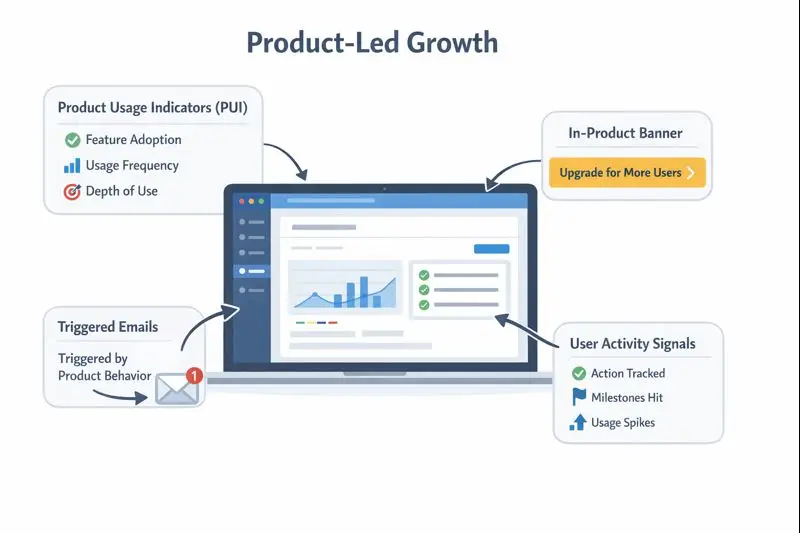
Task Define and operationalize a PQL framework by identifying product usage indicators (PUIs) that signal upgrade intent, then integrate those signals into marketing and sales workflows.
Action:
Identified high-intent product behaviors
Partnered with product and data teams to analyze usage data tied to upgrades
Identified missing signals and drove product instrumentation updates
Validated PUIs by segment, separating freemium → business behaviors from business → enterprise signals
Defined upgrade motions by segment
Freemium → Business: Focused on increasing license count by driving cross-functional collaboration and adoption across additional teams; recommended domain-level consolidation to a single freemium instance
Business → Enterprise: Prioritized the three PUIs with the strongest upgrade propensity as core PQL signals
Operationalized PQLs across systems
Integrated PUI data into Salesforce with Sales Ops and Marketo with Marketing Ops.
Built a PQL scoring model aligned to the existing MQL framework for clean handoff and prioritization
Results:
Established Atlassian’s foundational PQL framework
Aligned product, marketing, and sales around real product usage data
Shifted upgrades from volume-driven outreach to intent-based conversion and expansion
Doubling MQL:SQL Conversion for pipline growth
Compucom was generating leads, but too few MQLs were turning into real sales opportunities. This case study shows how I rebuilt the lead and nurture process to double MQL-to-SQL conversion, from 9% to 18%, and significantly improve pipeline quality.
Accelerating Enterprise Growth with ABM
Moving from SMB to enterprise required a complete reset of the go-to-market approach. This case study shows how I built an ABM program aligned to a distinct enterprise buying journey, designed to engage the right accounts earlier and support longer, more complex buying cycles.